
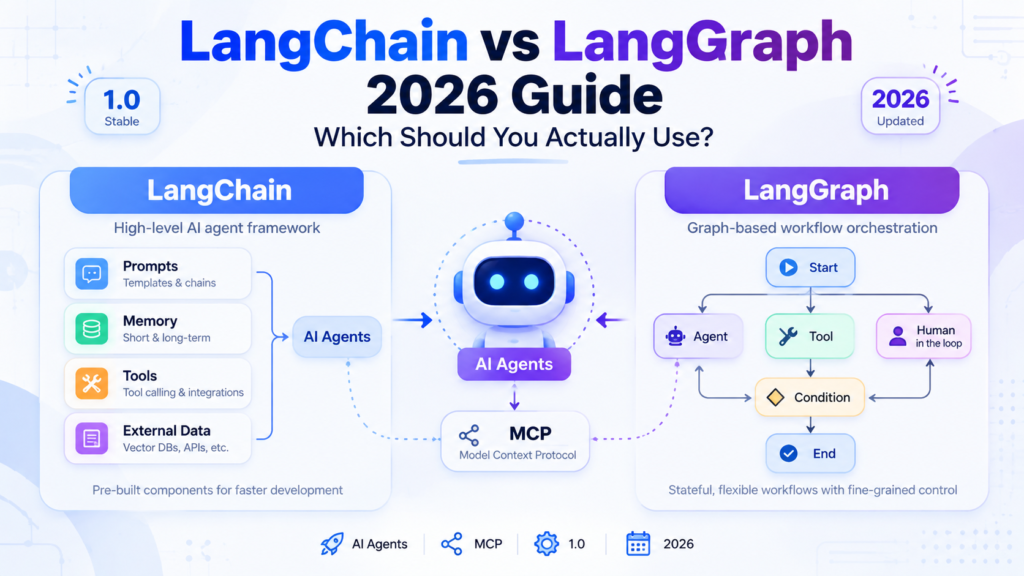
Every team building an AI agent in 2026 eventually hits the same question: LangChain or LangGraph. Both reached version 1.0 in October 2025, and both are still shipping updates every few weeks, which makes the LangChain vs LangGraph decision more confusing than it should be.
This LangChain vs LangGraph guide breaks down what each framework actually does, what changed recently, and which one fits your project. If you have read our earlier guide on building autonomous agents with LangChain and AutoGPT, think of this guide as the 2026 update covering how the ecosystem has moved on.
Understanding LangChain vs LangGraph starts with knowing how these two layers work together.
What Is LangChain?
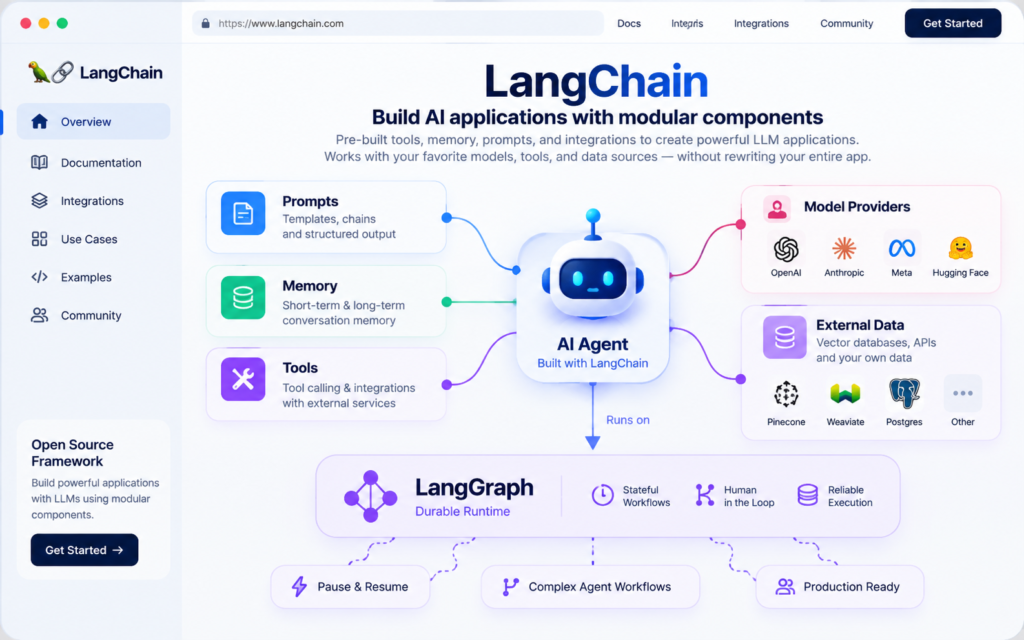
LangChain is an open-source framework for building applications powered by large language models. It gives developers pre-built components for prompts, memory, tool calling, and connecting to external data sources like vector databases.
Instead of writing this plumbing from scratch, LangChain lets you assemble an application from reusable pieces. It works with most major model providers, so switching between OpenAI, Anthropic, or an open-source model does not mean rewriting your entire app.
LangChain agents are now built directly on top of LangGraph, so the two frameworks are not really competitors anymore. They are layers of the same stack.
What Is LangGraph?
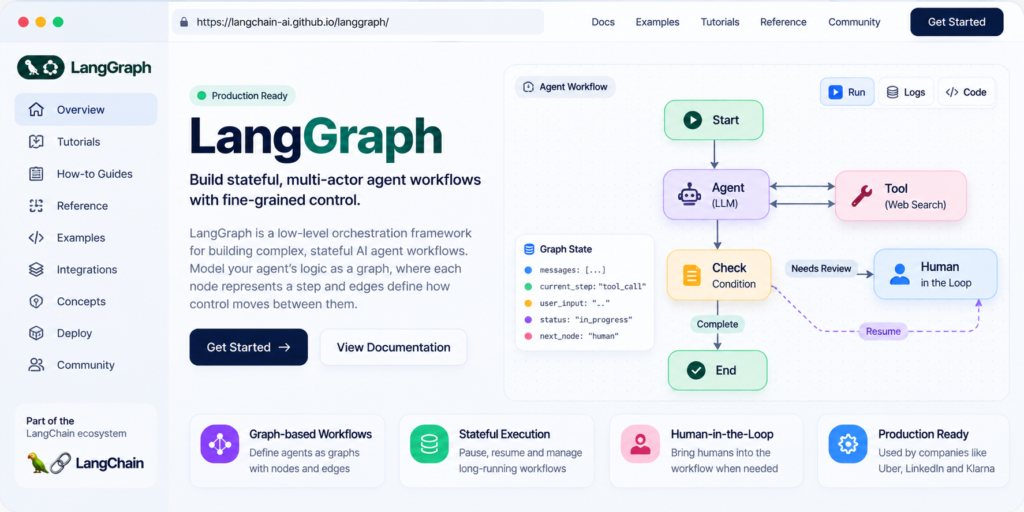
LangGraph is a lower-level orchestration framework, also built by the LangChain team, designed for workflows that need fine-grained control. It models an agent’s logic as a graph, where each node represents a step and edges define how control moves between them.
This graph-based structure makes LangGraph better suited for long-running, stateful workflows that need to pause, resume, or bring a human into the loop mid-process. Companies like Uber, LinkedIn, and Klarna use LangGraph in production for tasks like customer support automation and code migrations.
The trade-off is complexity. LangGraph gives you more control, but it also asks you to think in terms of state machines rather than simple chains.
LangChain vs LangGraph: Key Differences at a Glance
Here is how LangChain vs LangGraph compare on the factors that actually matter when choosing between them.
| Factor | LangChain | LangGraph |
|---|---|---|
| Abstraction level | High-level, pre-built patterns | Low-level, graph-based control |
| Best for | Fast prototypes, common agent patterns | Complex, stateful, long-running workflows |
| Learning curve | Easier for beginners | Steeper, requires state machine thinking |
| Human-in-the-loop support | Basic | Built-in, designed for it |
| Used by | Smaller teams, quick builds | Uber, LinkedIn, Klarna, Replit, Elastic |
| Relationship | Built on top of LangGraph | Powers LangChain’s agent layer |
The most significant difference between LangChain and LangGraph is the level of control you have over your agent workflow.
Why This Comparison Matters More in 2026
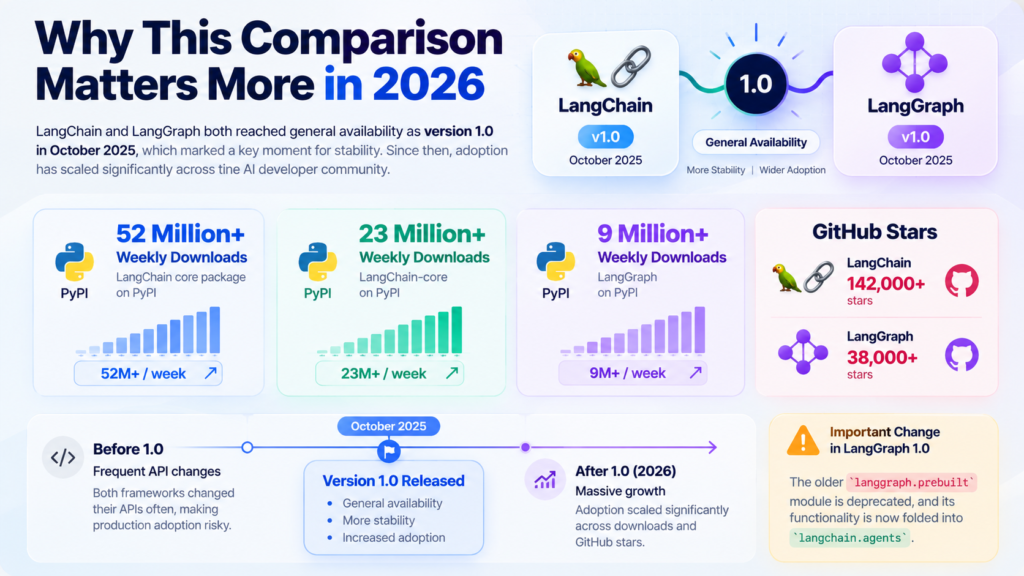
LangChain and LangGraph both reached general availability as version 1.0 in October 2025, which marked a key moment for stability.
Since hitting 1.0, adoption has scaled significantly. A few numbers put these figures in perspective:
- LangChain’s core package alone sees over 52 million downloads a week on PyPI
- LangChain-core adds another 23 million weekly downloads, and LangGraph adds roughly 9 million
- LangChain’s GitHub repository has crossed 142,000 stars, with LangGraph past 38,000
- LangGraph 1.0 deprecated the older
langgraph.prebuiltmodule, folding that functionality intolangchain.agents
That last point matters if you are working from an older tutorial. Code written before the 1.0 release may reference modules that no longer exist in the current version.
LangChain’s New MCP Support
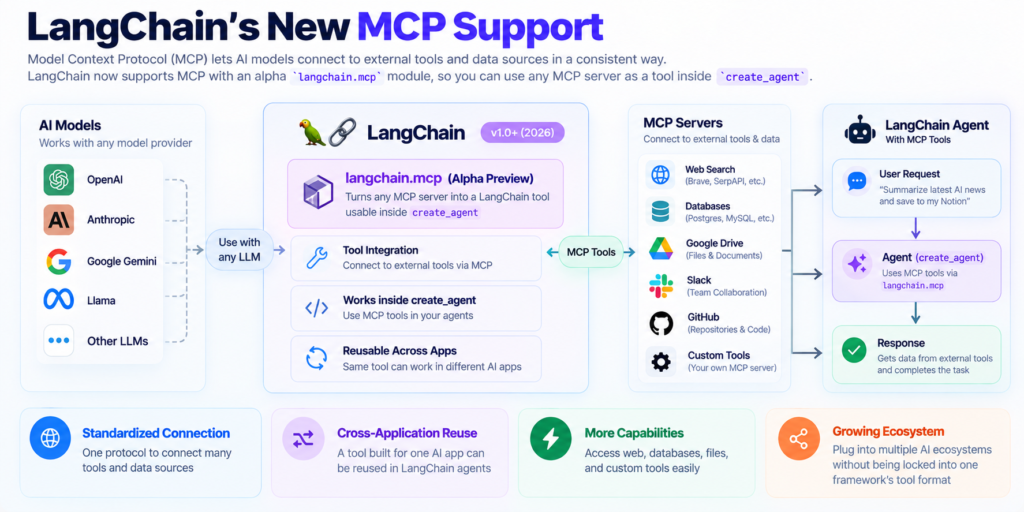
The LangChain vs LangGraph comparison has also become more relevant with the growing adoption of MCP.
One of the more interesting 2026 updates is LangChain’s growing support for the Model Context Protocol, or MCP. This is the emerging standard that lets AI models connect to external tools and data sources in a consistent way, regardless of which app built them.
LangChain shipped an alpha preview of a langchain.mcp module that turns any MCP server directly into a LangChain tool usable inside create_agent. This means a tool built for one AI application can now often be reused inside a LangChain agent with minimal extra work.
This is worth watching closely if you are building anything that needs to plug into multiple AI ecosystems rather than being locked into one framework’s tool format.
What Recent Security Issues Mean for You
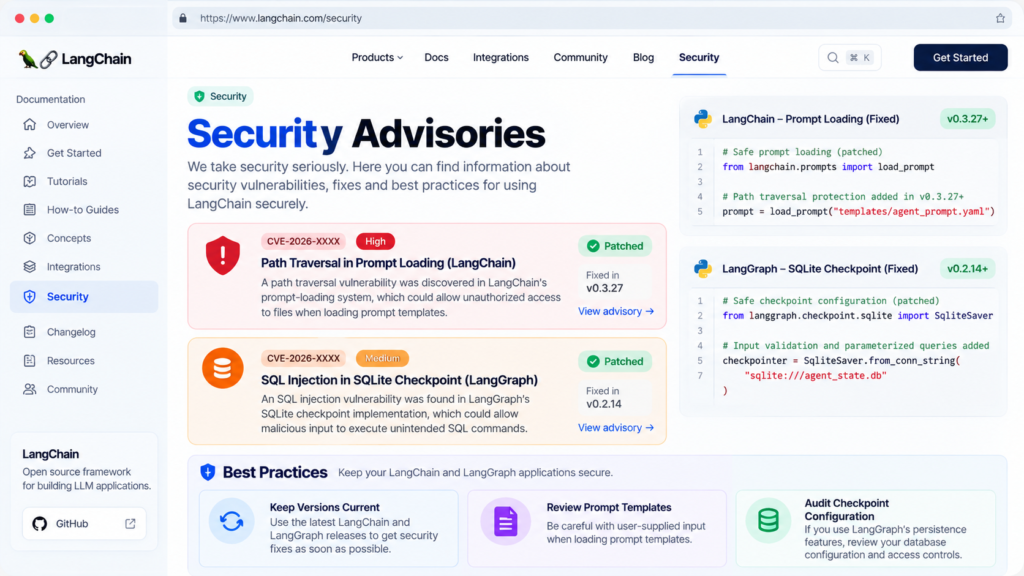
In March 2026, security researchers disclosed vulnerabilities affecting both frameworks. One issue involved a path traversal flaw in LangChain’s prompt-loading system, and another involved an SQL injection risk in LangGraph’s SQLite checkpoint implementation.
Both issues were patched quickly, but they are a useful reminder that these frameworks now sit inside production systems handling real data. A few practical takeaways:
- Keep your LangChain and LangGraph versions current rather than pinning to an old release indefinitely
- Review how prompt templates are loaded if you accept any user-supplied input
- Audit database checkpoint configurations if you use LangGraph’s persistence features
The key to the LangChain vs LangGraph decision is understanding how much control your AI workflow actually requires.
LangChain vs LangGraph: Which Should You Choose?
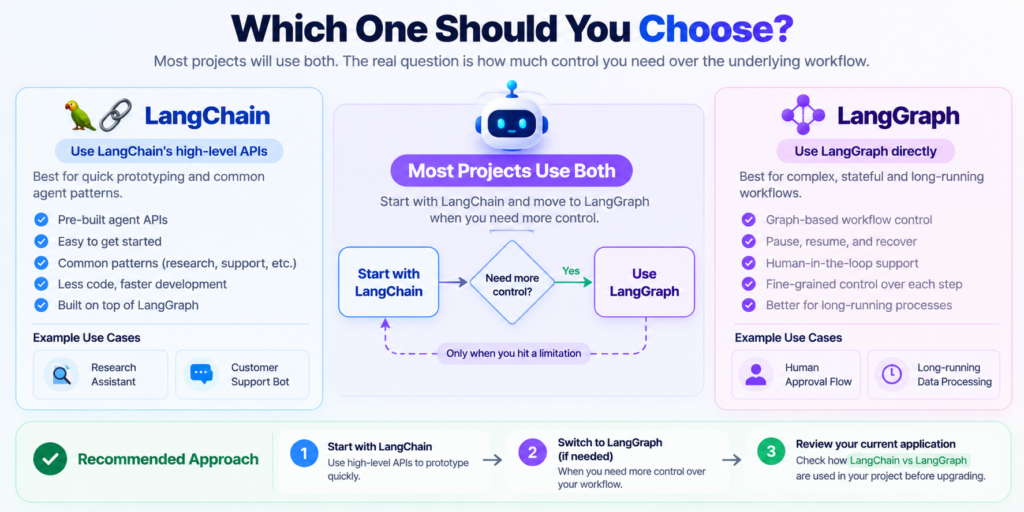
The honest answer is that most projects will end up using both, since LangChain’s agent APIs are now built on LangGraph underneath.
- Choose LangChain’s high-level APIs if you are prototyping quickly or building a common agent pattern like a research assistant or support bot
- Choose LangGraph directly if your workflow needs to pause for human approval, run for hours or days, or recover cleanly from a crash midway through
- Start with LangChain, and drop down to LangGraph only when you hit a limitation, rather than starting with the more complex option
Before upgrading, review how LangChain vs LangGraph are used in your current application.
A Quick Migration Checklist for LangChain 1.0
If you built something before the 1.0 release of either framework, a few checks can save you debugging time later. This LangChain vs LangGraph migration checklist covers the most common breakages teams run into.
- Replace any import
langgraph.prebuiltwith the equivalent inlangchain.agents - Confirm your LangChain and LangGraph versions match, since mismatched versions across the stack cause the most upgrade issues
- Re-test any custom tool integrations, since tool-calling behavior has been refined across recent releases
- Check whether your deployment pipeline can use the newer LangGraph deploy CLI, which simplifies shipping agents to production with a single command
None of these changes are hard, but skipping them is the most common reason teams get stuck mid-upgrade.
Where AutoGPT and Other Alternatives Fit
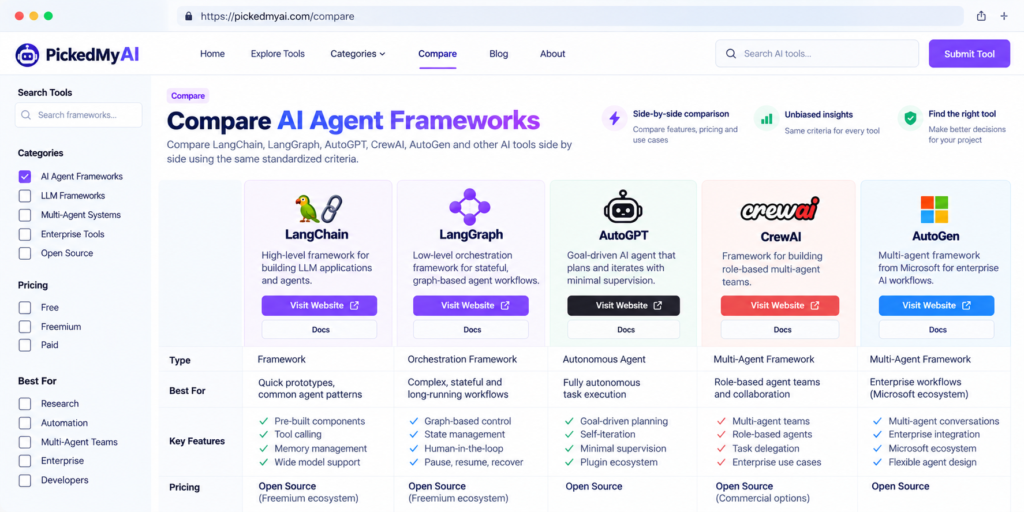
If you are comparing this to AutoGPT, the distinction is still relevant. AutoGPT is a goal-driven agent that plans and iterates with minimal supervision, while LangChain and LangGraph are structured frameworks you use to build and control that behavior yourself. Our earlier piece on LangChain and AutoGPT covers that distinction in more depth.
Beyond AutoGPT, frameworks like CrewAI and AutoGen have carved out their niches, CrewAI for role-based multi-agent teams and AutoGen for Microsoft-centric enterprise workflows. If you want to see how these stack up side by side, our comparison engine lets you evaluate agent frameworks and AI tools using the same standardized criteria.
For readers exploring the broader AI tools landscape beyond agent frameworks, our Marketing category and full AI tools directory cover everything from writing assistants to SEO platforms.
Frequently Asked Questions
Is LangGraph replacing LangChain? No. LangChain’s agent layer is now built directly on top of LangGraph, so they work together rather than competing. Most teams end up using both.
Which is easier for beginners, LangChain or LangGraph? LangChain’s high-level APIs are easier to start with. LangGraph requires thinking in terms of state machines, which is more challenging to learn.
Do I need to rewrite my LangChain agent for version 1.0? Possibly, if you relied on the older langgraph.prebuilt module, which was deprecated and folded into langchain.agents. Most other code should carry over with minimal changes.
What is MCP, and why does it matter for LangChain? MCP, or Model Context Protocol, is a standard for connecting AI models to external tools. LangChain’s new langchain.mcp module lets MCP-built tools work directly inside LangChain agents.
Is LangChain still relevant compared to newer agent frameworks? Yes. With over 50 million weekly downloads and adoption from companies like Uber and LinkedIn, LangChain remains one of the most widely used frameworks, alongside newer options like CrewAI and AutoGen.
Can I use LangChain and LangGraph together in the same project? Yes, and most production teams already do. A common setup uses LangChain’s high-level agent APIs for standard patterns, then drops into LangGraph directly for the specific workflow that needs finer control.
Want to go deeper? Read our original guide on LangChain and AutoGPT, explore the Marketing category, or compare AI agent frameworks and tools side by side.
Discussion (0)
No comments yet. Start the discussion below!
Leave a Comment