Sonam Wangchuk AI Innovation is more than just one man and one catchphrase. They are discussing how a mechanical engineer from an uneducated Himalayan village has spent more than thirty years transforming “we don’t have the budget for that” into “we built it anyway.” A new question about Wangchuk’s work is emerging as AI is changing almost every industry in the world: what happens when AI and Wangchuk’s economical, community-focused innovation approach collide?
This post breaks down his actual, documented tech contributions, how the UK & US news outlets are covering him today, where he stands now, and—the part most blogs skip—a grounded, honest look at how AI could plug into his projects in the future.
Quick Take: Engineer. Educator. Inventor of the Ice Stupa. Real-life inspiration for 3 Idiots. Currently on a 19-day hunger strike in Delhi. And possibly a preview of what "human-first AI" could look like if it ever reaches the Himalayas. Here's the full picture.Is Sonam Wangchuk developing artificial intelligence products? Is the Ice Stupa considered “intelligent technology”? What is the reason for his hunger strike in 2026? If any of those inquiries led you to this point, you have arrived at the correct location—this guide encompasses all three topics, in addition to precisely where AI, automation, and climate technology authentically converge with his three-decade oeuvre.
Table of Contents
1. Sonam Wangchuk AI Innovation: Who Is He?
2. Sonam Wangchuk’s Core Contributions to Technology
- The Ice Stupa: Water Engineering Without Electricity
- Passive Solar Architecture
- SECMOL: Reforming Education from the Ground Up
- HIAL: Rethinking Higher Education for Mountain Regions
3. Sonamngchuk vs. Silicon Valley: Can Frugal Engineering an
AI Automation and Actually Coexist?
4. How US and UK News Channels Are Covering Sonam Wangchuk
5. Sonam Wangchuk AI Innovation in 2026
6. Sonam Wangchuk AI Innovation: Where AI Could Fit In
7. Frequently Asked Questions (FAQ)
8. Why Sonam Wangchuk AI Innovation Matters – Final Thoughts
9. Sources
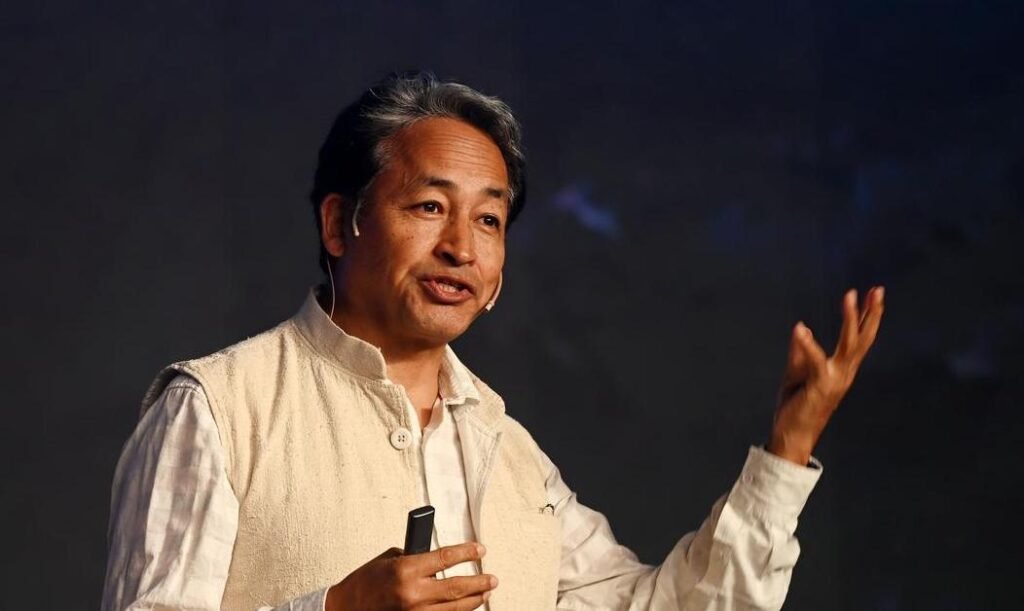
Sonam Wangchuk AI Innovation: Who Is He?
Wangchuk was born in 1966 near Alchi in Ladakh, a region that had no formal school nearby. His mother taught him at home in their native language until he was about nine years old. Later he earned a B.A. He did his mechanical engineering from NIT Srinagar in 1987 and later went on to study earthen architecture at CRAterre in Grenoble, France.
Some Bollywood fans might already know part of his story without realizing it: Wangchuk is believed to have inspired Phunsukh Wangdu, Aamir Khan’s character in 3 Idiots.
Sonam Wangchuk AI Innovation has become a growing topic of interest as people explore how his sustainable engineering philosophy could intersect with artificial intelligence in the future.
Sonam Wangchuk’s Core Contributions to Technology
The crux of any discussion about Sonam Wangchuk’s AI innovation is that Wangchuk was already solving difficult engineering problems with almost none of the resources that big tech typically assumes are necessary, even before AI became involved.
30-second stat check: 0 electricity grids used. ~15 international awards won. 1 Bollywood character inspired. That's the resume before AI even enters the conversation.1. The Ice Stupa, Water Engineering Without Electricity
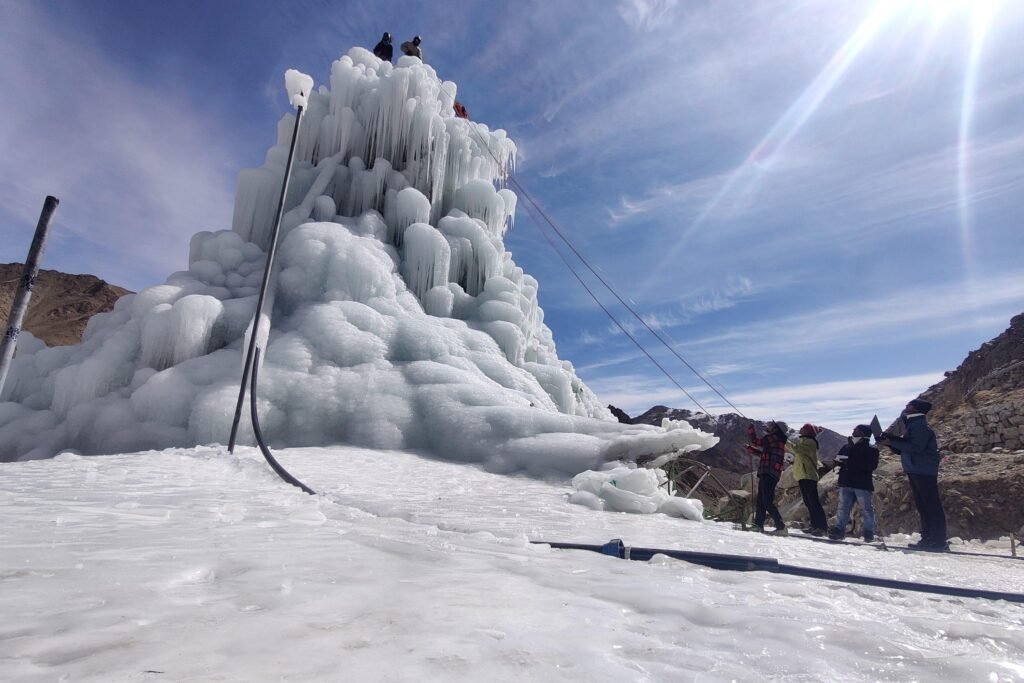
His most renowned invention is the Ice Stupa, a cone-shaped artificial glacier that has been designed to preserve winter meltwater as ice and to release it slowly during spring, when farmers need irrigation water the most. No pumps, no electricity grid, no imported parts. Gravity, geometry, and a keen understanding of the local climate.
The success of the Ice Stupa demonstrates why Sonam Wangchuk AI Innovation is often associated with practical, low-cost solutions for climate challenges.
2. Passive Solar Architecture
Working with students, Wangchuk developed the idea to build mud-and-earth structures that stay at approximately +15°C inside even when it is -15°C outside, without any form of heating. It is a lesson in inexpensive thermal engineering with completely indigenous materials.
3. SEMCOL—Reforming Education From the Ground Up
In 1988, Wangchuk co-founded the Students’ Educational and Cultural Movement of Ladakh (SECMOL), a school that runs entirely on solar power and teaches through hands-on, real-world problem-solving instead of rote learning.
Through SECMOL, Sonam Wangchuk AI Innovation emphasizes hands-on learning, renewable energy, and community-driven technological development
4. HIAL, Rethinking Higher Education for Mountain Regions
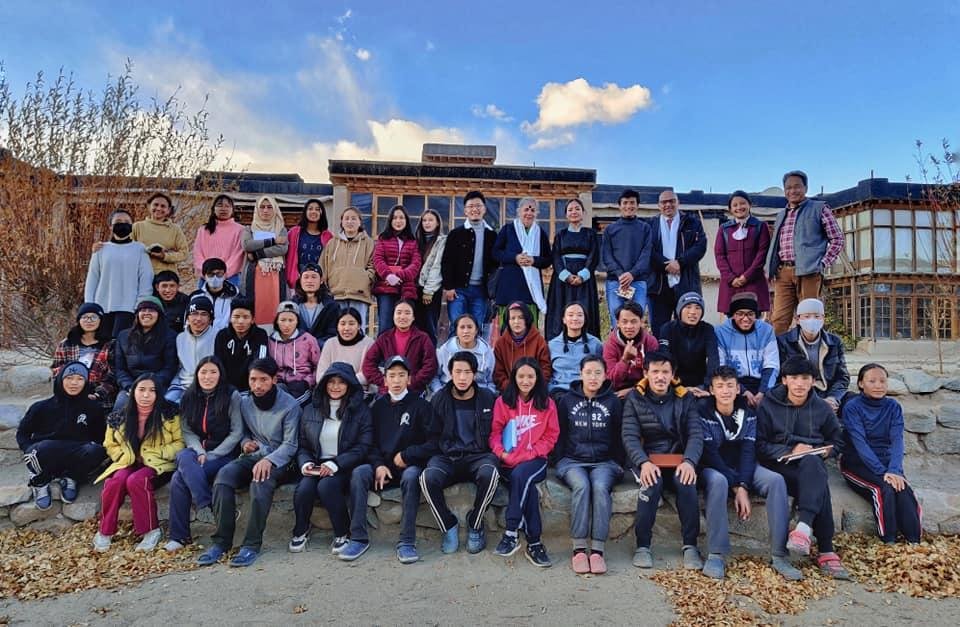
He and his wife, Gitanjali J. Angmo, founded HIAL in 2016. HIAL combines engineering, renewable energy, entrepreneurship, and sustainable design in a hands-on curriculum for high-altitude communities, a transdisciplinary model many AI-era universities are just beginning to adopt.
Wangchuk has won nearly 15 international awards, including the 2018 Ramon Magsaysay Award and the 2017 Global Award for Sustainable Architecture.
The vision behind HIAL reflects Sonam Wangchuk AI Innovation, combining sustainable architecture, education, and future-ready technologies.
Sonam Wangchuk vs. Silicon Valley: Can Frugal Engineering and AI Automation Actually Coexist?
Here’s where the comparison gets particularly compelling. Wangchuk’s approach and the typical AI-startup playbook solve problems in almost opposite ways—which is precisely why pairing them is such an intriguing thought experiment.
The one-line version: Silicon Valley scales with more data and more compute. Wangchuk scales with less of everything. So what happens if you combine "less" with "smart"?| Factor | Sonam Wangchuk’s Model | Typical AI/Big-Tech Model |
| Core tool | Passive solar design, gravity, local materials | Machine learning, generative AI, cloud compute |
| Cost structure | Near-zero, built from what’s locally available | High upfront investment in data and infrastructure |
| Scalability | Community-led, one village at a time | Cloud-based, scales globally overnight |
| Dependency | Runs without electricity or internet | Depends on connectivity, servers, and power |
| Feedback loop | Direct—communities see results in one season. | Data-driven—models improve over many cycles. |
| Talent model | Students-as-builders (SECMOL/HIAL learn-by-doing) | Specialized engineers, data scientists, ML researchers |
| Risk profile | Physical, visible, local (weather, terrain, water) | Data bias, model drift, algorithmic opacity |
| Best-case outcome | A self-sufficient village or school | A self-improving, automated system |
Wangchuk’s projects lack predictive power at scale, and most AI automation projects lack grounding in real, resource-constrained communities. Together, they address each other’s most significant weaknesses.
Which model wins long-term, frugal engineering or AI-first automation? Truthfully, neither wins alone. The most resilient “smart automation” in climate-vulnerable regions will combine Wangchuk’s cost discipline and Silicon Valley’s predictive tooling.
While there are no confirmed AI products today, Sonam Wangchuk AI Innovation could inspire future applications in climate prediction, smart irrigation, and AI-assisted education.
How US and UK News Channels Are Covering Sonam Wangchuk
The last two years have seen Wangchuk’s international coverage change. CNN (US) covered his hunger strike in support of the Gen Z–led Cockroach Janta Party, which wants answers for exam-paper leaks that affected millions of students. BBC (UK) has covered his activism, including a 2024 fast over Ladakh’s ecological future. He recently described himself as physically weak but internally strong. They view him as an engineer, educator, and protest leader in Indian national politics rather than a regional figure.
Sonam Wangchuk AI Innovation in 2026
As of mid-July 2026, Wangchuk is on an indefinite hunger strike at Jantar Mantar in New Delhi, which he began on June 28 in support of a sit-in that is demanding the resignation of India’s education minister over the NEET-UG paper-leak scandal.
By the numbers: Fast Days 18-19: ~9 kg down. 24-hour medical supervision. Only water and salt.
Doctors warned his vital organs could be affected if he continued fasting, and he has carried on despite pleas to stop. This episode isn’t his first high-stakes fast; he spearheaded a 21-day fast in 2024 for Ladakh statehood and then a 35-day fast in 2025 that resulted in a fast he under the National Security Act revoked in March 2026.
Sonam Wangchuk AI Innovation: Where AI Could Fit In
Wangchuk hasn’t built an AI product, nothing statehood and statehood product, nothing product, nothing product, nothing. He claims otherwise. But his “simplest tool that solves the local problem” philosophy maps well onto a few forward-looking, unconfirmed possibilities:
- Climate engineering and predictive AI models on weather, melt, and terrain data could help plan Ice Stupa placement across valleys.
- Classrooms and AI tutoring adapted for low-connectivity regions could extend SECMOL/HIAL’s hands-on model to remote students.
- Quiet infrastructure: if AI ever enters HIAL, it’s more likely to be a water prediction or building optimization than a branded chatbot, consistent with his preference for invisible, durable tools.
As environmental challenges grow, Sonam Wangchuk AI Innovation provides valuable lessons on combining local knowledge with emerging technologies.
FAQ
Does Sonam Wangchuk use AI in his projects? Not currently. His documented work is physical engineering and education, not software.
Is the Ice Stupa “smart” tech? No, it’s deliberately low-tech, using only gravity and geometry.
Why is he on hunger strike in 2026? An indefinite fast has been ongoing since June 28, demanding the education minister’s resignation over the NEET-UG paper-leak scandal.
Is he the inspiration for 3 Idiots? Yes, widely credited as the basis for Phunsukh Wangdu.
What did he find? SECMOL (1988) and HIAL (2016, with wife Gitanjali J Angmo).
Could AI ever reach HIAL or SECMOL? This is plausible but unconfirmed, and it is likely to be quiet infrastructure rather than a flashy app.
Why Sonam Wangchuk AI Innovation Matters and Final Thoughts
Wangchuk’s career is a reminder that durable innovation doesn’t require venture funding or a power grid. Whether or not AI formally enters his work, the real question it raises is whether AI can be built with the same discipline: solve the real problem, use the least you need, and make sure the community can run it without you.
Ultimately, Sonam Wangchuk AI Innovation is not just about artificial intelligence—it is about using technology responsibly to solve real-world problems and improve lives.
Visit this blog: Claude Fable 5: Shocking Truth Before You Use It (2026) for insights!
Sources referenced: BBC, CNN, Al Jazeera, Wikipedia, and the Ramon Magsaysay Award Foundation.
Discussion (0)
No comments yet. Start the discussion below!
Leave a Comment