
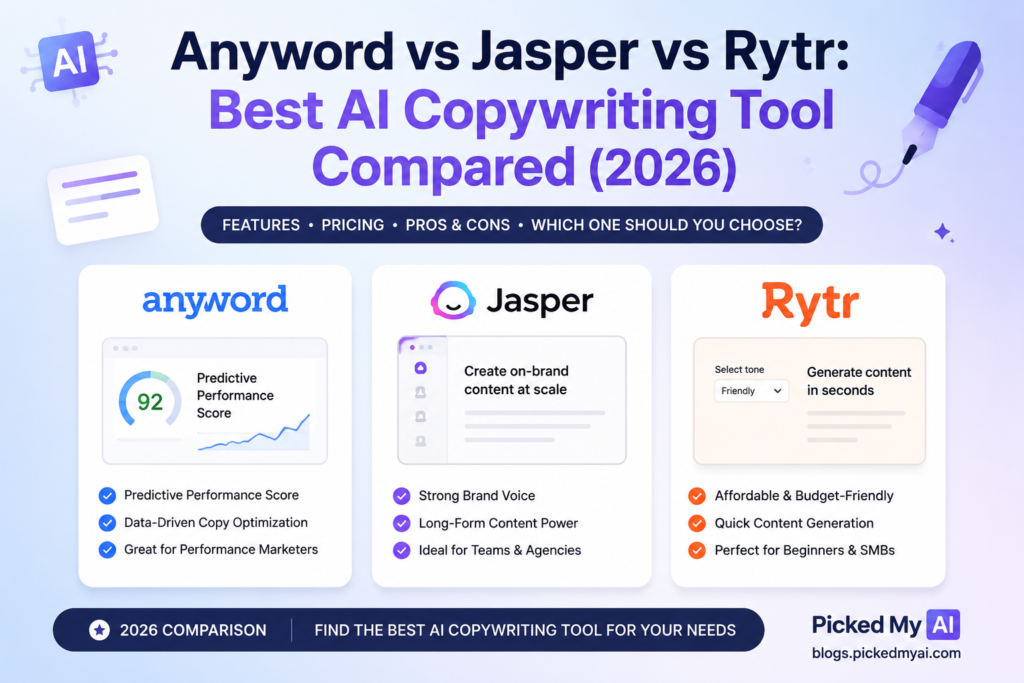
If you search for “best AI copywriting tool” in 2026, three names keep showing up: Anyword, Jasper, and Rytr. All three generate marketing copy, but they solve different problems and target different budgets.
Anyword is built for performance marketers who want to predict how copy will convert before it goes live. Jasper is built for brand-focused teams who need consistent, on-brand content at scale. Rytr is built for solo creators who want quick, cheap short-form copy without the enterprise price tag.
This guide breaks down pricing, features, and real use cases so you can pick the right tool instead of guessing.
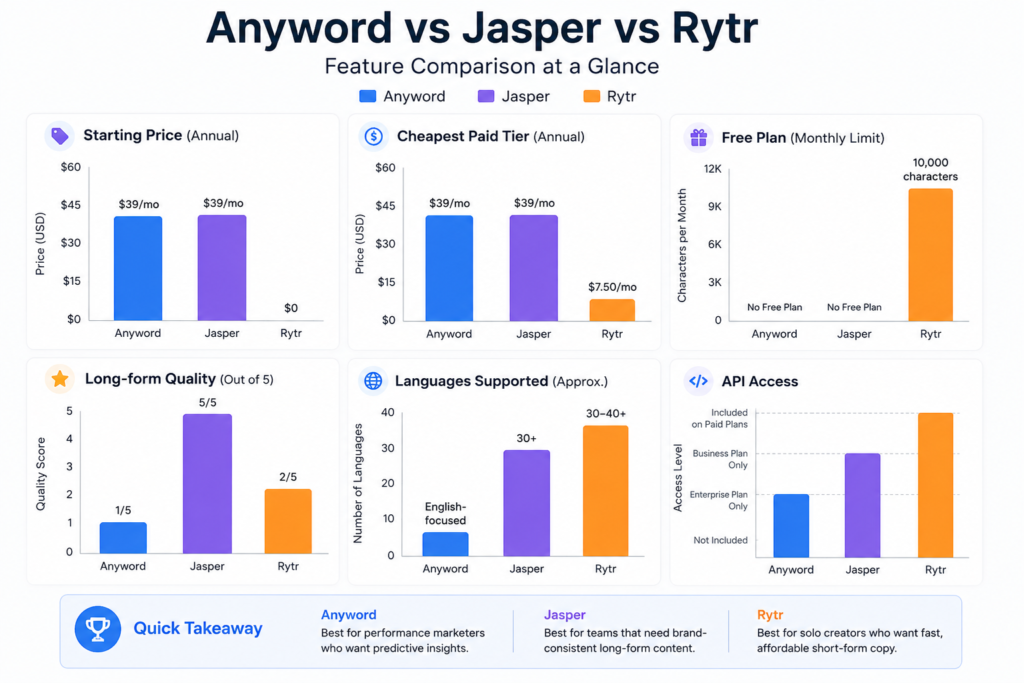
Quick Comparison Table
| Feature | Anyword | Jasper | Rytr |
|---|---|---|---|
| Starting price | $39/mo (annual) | $39/mo (annual, Creator) | Free |
| Cheapest paid tier | $39/mo | $39/mo | $7.50/mo (annual) |
| Free plan | No (7-day trial) | No (7-day trial) | Yes, 10,000 chars/mo |
| Core strength | Predictive Performance Score | Brand Voice + Canvas editor | Price and speed |
| Best for | Ads, emails, landing pages | Long-form, brand-consistent content | Short-form copy on a budget |
| Long-form quality | Weak, text-only, short-form focus | Strong | Weak, repetitive past 600 words |
| Languages | English-focused | 30+ | 30-40+ |
| Team seats | 1 to custom | 1 to custom | Basic team plans |
| API access | Enterprise plan only | Business plan only | Included on paid plans |
Anyword: Best for Performance Marketers
Anyword’s standout feature is its Predictive Performance Score. It analyzes generated copy against billions of marketing data points and scores each variation before you publish, so you know which headline or ad is likely to convert.
Pricing starts at $39/month on the Starter plan (annual billing) or $49/month on a monthly basis, with unlimited copy generation but limited performance predictions. The data-driven plan runs $79/month annually and adds real-time scoring plus three seats. Business and enterprise tiers are custom-priced and add custom AI models and campaign data integration.
The trade-off is scope. Anyword is optimized for short-form, high-conversion copy like ads, emails, and landing pages. It is not designed for long-form blog content, so teams publishing articles regularly will still need another tool alongside it.
Anyword makes sense if you run paid ads or email campaigns and want data behind your copy decisions, not just faster drafts.
For performance-focused marketers, Anyword can be the best AI copywriting tool when conversion data matters more than long-form content.
Jasper: Best for Brand-Consistent Content Teams
Jasper’s biggest differentiator is brand voice. You upload existing content, and Jasper learns your tone, vocabulary, and sentence structure, then applies it consistently across every piece a team produces.
The Creator plan starts at $39/month annually ($49 monthly) for one seat and one brand voice. The Pro plan, Jasper’s most popular tier, costs $59/month annually ($69 monthly) and adds more seats, brand voices, and the Canvas editor. Business pricing is custom and typically starts around $900+/month for teams that need API access, unlimited brand voices, and SSO.
Jasper produces stronger long-form content than both Anyword and Rytr, and its Surfer SEO integration helps content teams optimize articles while writing. The downside is cost. At $59-$69 per seat, it is priced well above Rytr and roughly in line with Anyword, but it lacks Anyword’s conversion-prediction data.
For brand-focused teams, Jasper can be the best AI copywriting tool when consistency and long-form content are the top priorities.
Rytr: Best for Budget-Conscious Solo Creators
Rytr’s entire pitch is affordability without sacrificing basic usability. The free plan includes 10,000 characters a month, which is enough to test the tool properly before paying anything.
The Saver plan costs $9/month ($7.50 billed annually) and removes character limits entirely for one language. The Premium plan is $29/month ($24.16 annually) and adds 35+ languages, custom use cases, and 100 monthly plagiarism checks. Both paid tiers include a Chrome extension and API access, which Anyword and Jasper only offer on higher tiers.
Rytr covers 40+ templates for product descriptions, ad copy, emails, and social captions, and its output is genuinely quick. The catch is long-form quality. Past roughly 600 words, Rytr’s output tends to repeat phrasing and lose coherence, so it works best for short, templated writing rather than full articles.
Rytr fits freelancers, small businesses, and solo bloggers who need quick short-form drafts and cannot justify a $50+ monthly subscription.
For budget-conscious creators, Rytr may be the best AI copywriting tool when affordability and speed matter most.
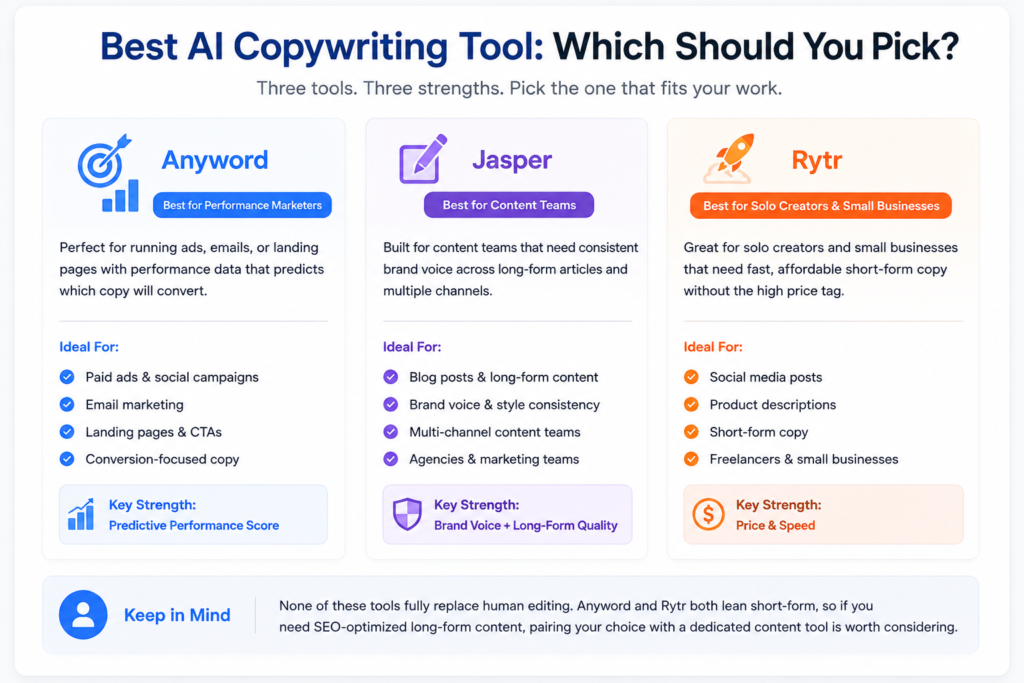
Best AI Copywriting Tool: Which Should You Pick?
Choose Anyword if your main job is running ads, emails, or landing pages and you want performance data guiding your copy decisions. Choose Jasper if you manage a content team that needs consistent brand voice across long-form articles and multiple channels.
None of these tools fully replace human editing. Anyword and Rytr both lean short-form, so if you need SEO-optimized long-form content, pairing your choice with a dedicated content tool is worth considering.
Frequently Asked Questions
Is Anyword better than Jasper? Anyword is better for predictive, conversion-focused ad and email copy. Jasper is better for long-form, brand-consistent content across a team. They solve different problems rather than directly competing.
Is Rytr good enough to replace Jasper? For short-form copy like product descriptions and social posts, yes. For long-form blog content or brand voice management, Jasper is the stronger choice.
Which tool has the best free plan? Rytr is the only one of the three with a permanent free plan. Anyword and Jasper both offer 7-day free trials only.
Can I use more than one of these tools together? Yes. Many marketing teams use Rytr or Anyword for fast short-form drafts and Jasper for polished, brand-consistent long-form content.
Explore more AI writing tools in our Marketing category or compare tools side-by-side using our comparison engine.
Discussion (0)
No comments yet. Start the discussion below!
Leave a Comment