PickedMyAi
When people search Writesonic vs AssemblyAI, they’re usually trying to solve one of two problems: which tool to buy, or how these tools even fit together in a real workflow. The honest answer is that Writesonic, AssemblyAI, LangChain automation, and Gamma.app aren’t competitors. Each one handles a different stage of an AI-powered pipeline, and most serious 2026 workflows use three or four of them together.
This guide compares all four directly, includes a working LangChain autonomous agent tutorial, and ends with a decision framework so you know exactly what to use and when.
Writesonic vs AssemblyAI vs LangChain vs Gamma.app: Quick Comparison Table
| Tool | Category | Core Job | Best For |
|---|---|---|---|
| Writesonic | Content generation | Turns ideas into publishable text | Marketers, content agencies |
| AssemblyAI | Speech-to-text API | Turns audio into structured text | Developers, call/meeting analytics |
| LangChain | Automation framework | Chains LLM calls into autonomous agents | Developers building multi-step workflows |
| Gamma.app | Presentation design | Turns text into designed decks | Founders, consultants |
Writesonic vs AssemblyAI: Key Differences
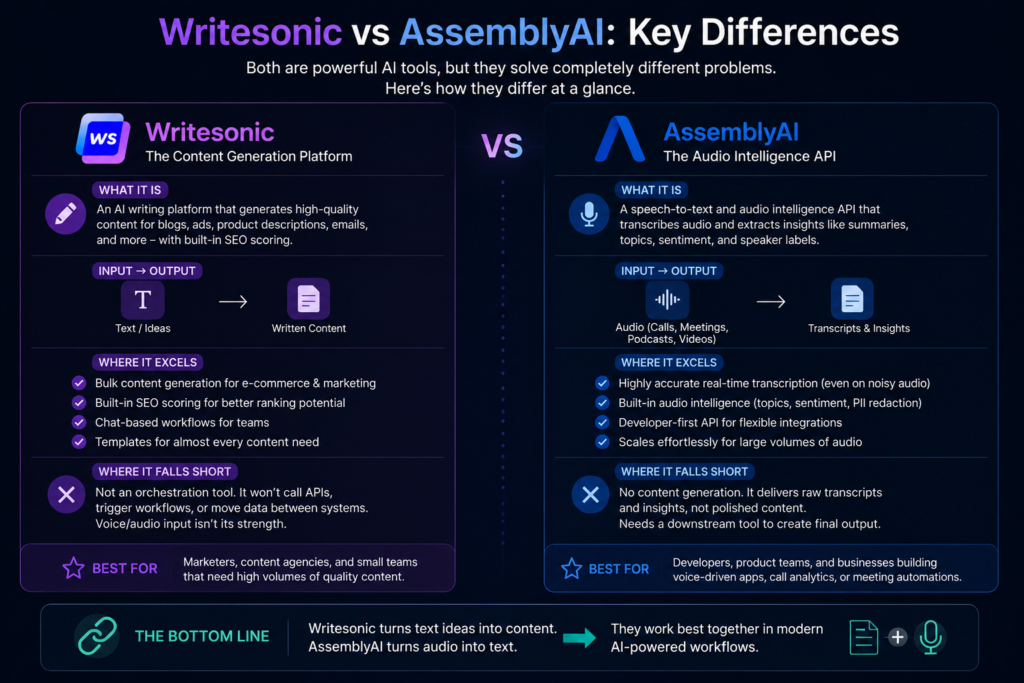
The Writesonic vs AssemblyAI comparison confuses people because both get filed under “AI tools,” but they don’t overlap at all.
Writesonic is a content-generation platform. It writes blog posts, ad copy, and product descriptions, with built-in SEO scoring so output isn’t just generic filler. It’s built for volume: e-commerce catalogs, bulk ad variations, chat-based drafting for teams that don’t want to prompt-engineer from scratch.
AssemblyAI is a speech-to-text and audio intelligence API. It takes calls, meetings, or podcast audio and converts it into transcripts, summaries, sentiment tags, and speaker labels. On its own, it stops at the transcript stage, generating the actual finished output (a report, an email, a summary) is someone else’s job, whether that’s Writesonic or a LangChain-based agent picking up from there. A simple way to remember the split: text going in and more text coming out points to Writesonic. Audio going in points to AssemblyAI, but it always needs a second tool to carry the work across the finish line.
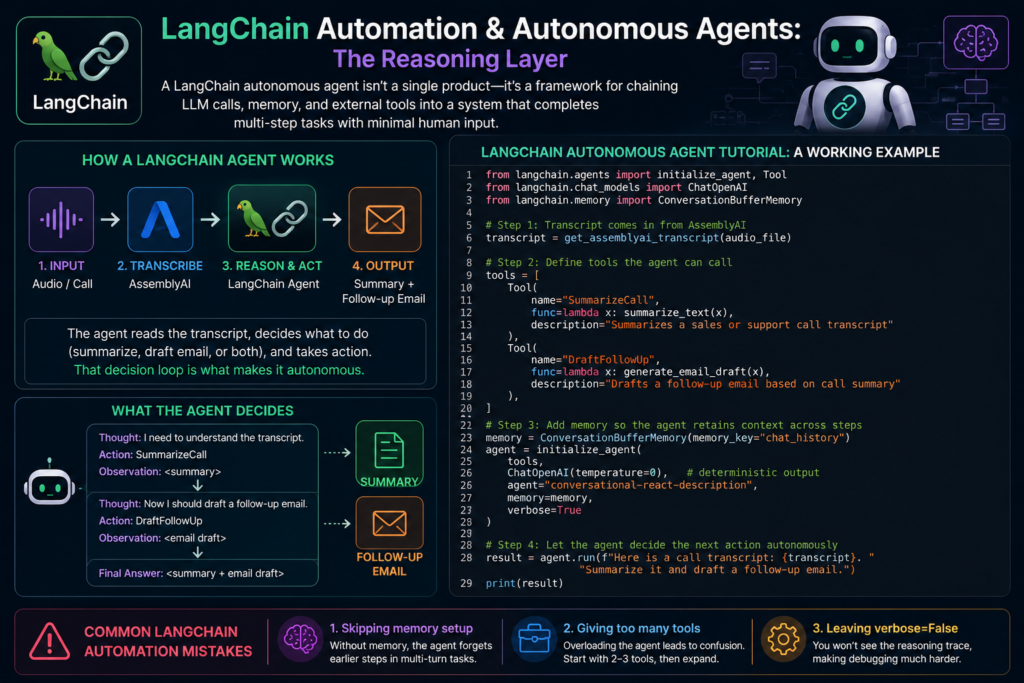
LangChain Automation & Autonomous Agents: The Reasoning Layer
A LangChain autonomous agent isn’t something you download and open, it’s more like a blueprint for wiring together language model calls, stored context, and outside tools so the whole system can work through several steps on its own, without someone approving each move.
LangChain Autonomous Agent Tutorial: A Working Example
Here’s an agent that takes an AssemblyAI transcript and decides on its own whether to summarize it, draft a follow-up email, or both:
python
from langchain.agents import initialize_agent, Tool
from langchain.chat_models import ChatOpenAI
from langchain.memory import ConversationBufferMemory

# Step 1: Transcript comes in from AssemblyAI
transcript = get_assemblyai_transcript(audio_file)

# Step 2: Define tools the agent can call
tools = [
    Tool(
        name="SummarizeCall",
        func=lambda x: summarize_text(x),
        description="Summarizes a sales or support call transcript"
    ),
    Tool(
        name="DraftFollowUp",
        func=lambda x: generate_email_draft(x),
        description="Drafts a follow-up email based on call summary"
    ),
]

# Step 3: Add memory so the agent retains context across steps
memory = ConversationBufferMemory(memory_key="chat_history")
agent = initialize_agent(
    tools,
    ChatOpenAI(temperature=0),
    agent="conversational-react-description",
    memory=memory,
    verbose=True
)

# Step 4: Let the agent decide the next action autonomously
result = agent.run(f"Here is a call transcript: {transcript}. Summarize it and draft a follow-up email.")
print(result)
Common LangChain Automation Mistakes
- Skipping memory setup, so the agent forgets earlier steps in multi-turn tasks
- Giving the agent too many tools at once instead of starting with 2 to 3
- Leaving
verbose=Falseduring development, which hides the reasoning trace needed for debugging
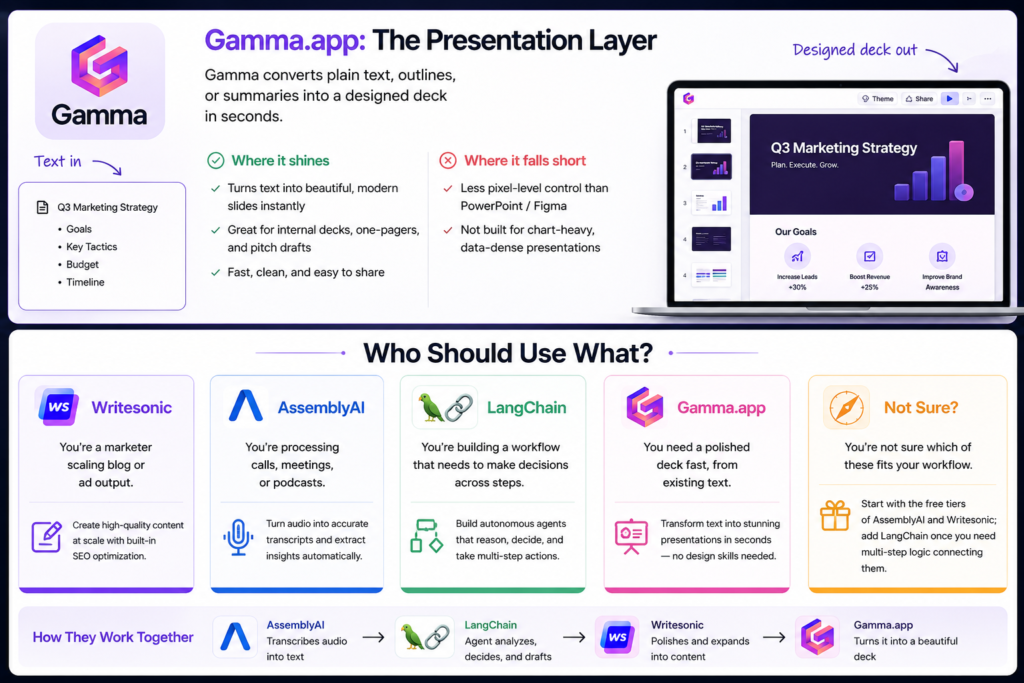
Gamma.app: The Presentation Layer
Gamma converts plain text, outlines, or summaries into a designed deck in seconds. It’s fast and clean for internal decks and pitch drafts, though it offers less pixel-level control than manual design tools and isn’t built for chart-heavy, data-dense presentations.
Who Should Use What?
- You’re a marketer scaling blog or ad output → Writesonic
- You’re processing calls, meetings, or podcasts → AssemblyAI
- You’re building a workflow that needs to make decisions across steps → LangChain automation
- You need a polished deck fast, from existing text → Gamma.app
- You’re not sure which of these fits your workflow → Start with the free tiers of AssemblyAI and Writesonic; add LangChain once you need multi-step logic connecting them
The Full Pipeline: How They Work Together
- AssemblyAI transcribes a sales call or meeting
- A LangChain agent reads the transcript and drafts a summary plus action items
- Writesonic polishes that summary into a client-ready report
- Gamma.app turns the final output into a shareable deck
FAQs
Is LangChain a tool or a framework? A framework, a set of building blocks for chaining LLM calls, memory, and external tools into an agent.
Can AssemblyAI and Writesonic be used together? Yes. AssemblyAI transcribes audio, and Writesonic turns that transcript into polished content.
Do I need to code to build a LangChain autonomous agent? Basic Python is recommended, though no-code agent builders exist for simpler use cases.
Is Gamma.app free? Gamma has a free tier with generation limits; paid plans add more exports and branding controls.
Conclusion
The Writesonic vs AssemblyAI debate, and the wider question of where LangChain and Gamma.app fit, comes down to one idea: these tools solve different problems in the same pipeline. Match the tool to the stage of your workflow, not the other way around.
Ready to pick your stack? [Explore our full AI tool comparison hub →]
Discussion (0)
No comments yet. Start the discussion below!
Leave a Comment