
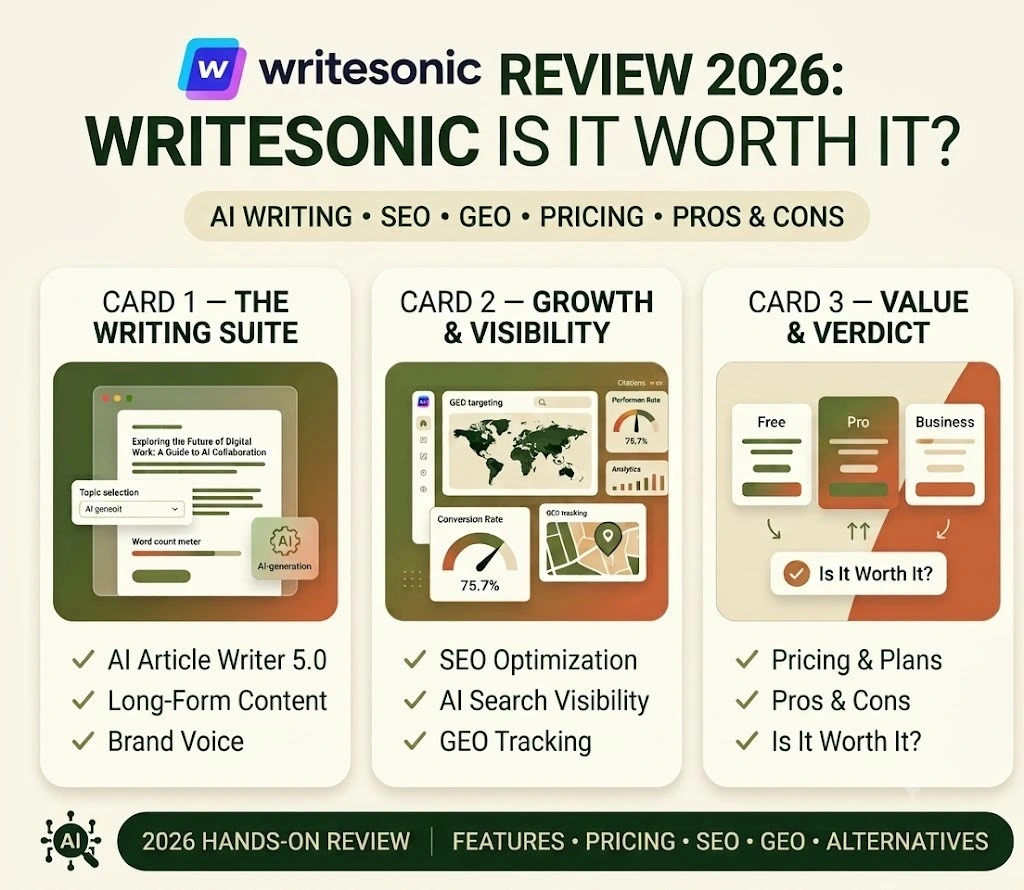

I’ll be straight up why I wrote this. I kept seeing Writesonic AI pop up everyplace in reddit threads, in “best AI writer” roundups, in ads on my own feed and I got tired of reading recycled opinions from people who clearly never opened the dashboard. So I signed up myself, ran it through real blog work for a few weeks, and I’m putting everything I found into this Writesonic review so you don’t have to gamble your subscription money like I did.
I make my living writing content. So I judged Writesonic like any tool I’m paying for. Will it really save me hours? Is it good for SEO-content Is it legit or just another overhyped AI wrapper?
This is all I learned in this Writesonic review 2026.
What Is Writesonic AI, Exactly?
Writesonic started in 2020 as a barebones AI copywriting tool the kind of app you’d fire up to spit out ad headlines or product blurbs in seconds. That’s not true anymore. 3-in-1 AI Search Visibility and content platform Writesonic rebranded as a full-fledged AI Search Visibility and content platform in 2026. A fancy phrase for saying it now does three things at once: creates content, audits your site for SEO, and monitors your brand presence within AI answer engines like ChatGPT, Gemini, and Google AI Overviews.
That last part is what’s called GEO Generative Engine Optimization and I’ll get into that in detail in a minute, because it’s honestly the most interesting shift in the product since I first tried it years ago.
Writesonic is also not running on a single model under the hood. Depending on the task it routes your requests through several large language models including OpenAI’s GPT-4o and o1, Anthropic’s Claude, Google’s Gemini, Flux 1.1 and others. Writesonic’s Chatsonic experience gives you access to multiple AI models. That multi-model setup is one reason the output seems more varied than tools locked into one model. You can see the current lineup yourself at the official Writesonic website, where they list which models power each feature.
Source: Writesonic GEO documentation
Writesonic Chatsonic
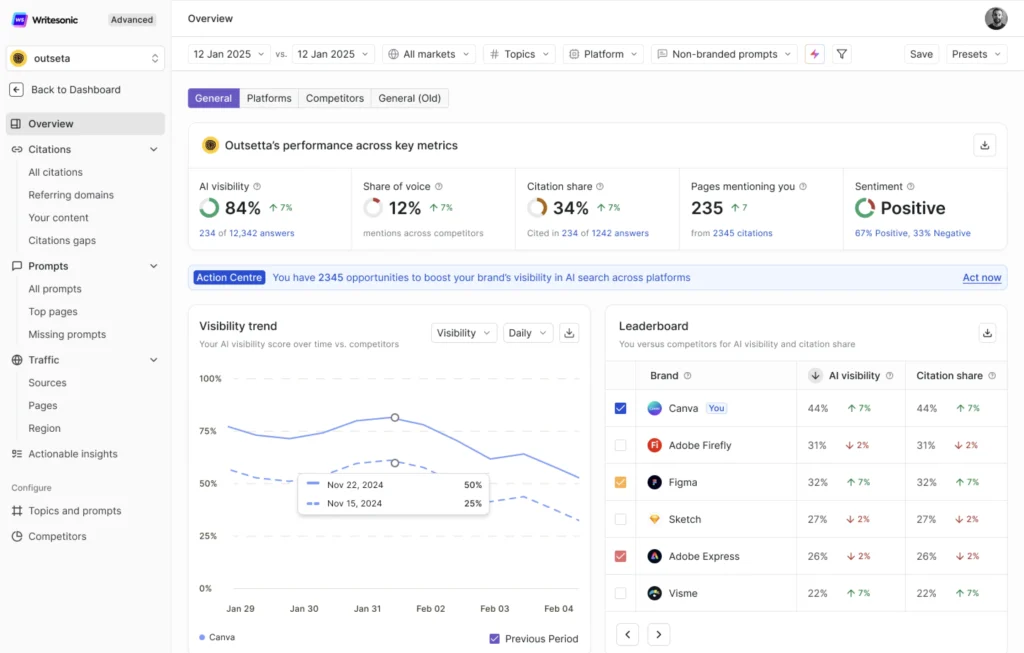
Here’s what I actually used during my month of testing, broken down by what I found useful vs. what felt like filler.
AI Article Writer: This is the main engine and the one that most people sign up for. You provide it with a topic, a target keyword and a tone and it will write a multi-section article with headings in place. I actually found the outlines to be solid, better organized than a blank prompt in chatGPT.
Chatsonic: This is the chat interface from Writesonic, for real-time research, not just generation. Unlike a frozen model on a training cut-off, Chatsonic pulls in current data, so it’s useful when you’re writing about something that happened last week and a static AI model would just guess.
SEO Checker & Optimizer: Compares your draft to the pages that rank highest for your chosen keyword and highlights any areas that need improvement, such as thin sections, low keyword density, or missing subtopics. Because it transforms the question “does this sound fine?” into a concrete, quantifiable checklist, I relied on it extensively.
Brand Voice: You can give it examples of your own writing and it will attempt to match your tone in future drafts. It’s not perfect, but it did noticeably reduce my editing time on repeat blog posts for the same brand.
Templates Library: There are 80-plus templates for everything from Facebook ad copy to product descriptions to YouTube scripts. I only used a handful but if you’re doing scattered marketing copy instead of long-form blogging this section alone might be worth the subscription.
Site Audits: Writesonic will crawl your website and flag technical and on-page SEO issues, like you would expect from a dedicated auditing tool, just bundled into the same subscription, instead of a separate one.
Integrations: I used it integrated with WordPress to publish directly while setting it up, but it also integrates with Google Chrome, Zapier and a couple other tools depending on your plan. This saves real steps if you are running a content pipeline rather than writing one post at a time.
GEO & SEO Optimization Features
This is the part I believe most 2025-era reviews are missing, because Writesonic’s entire identity changed here in 2026.
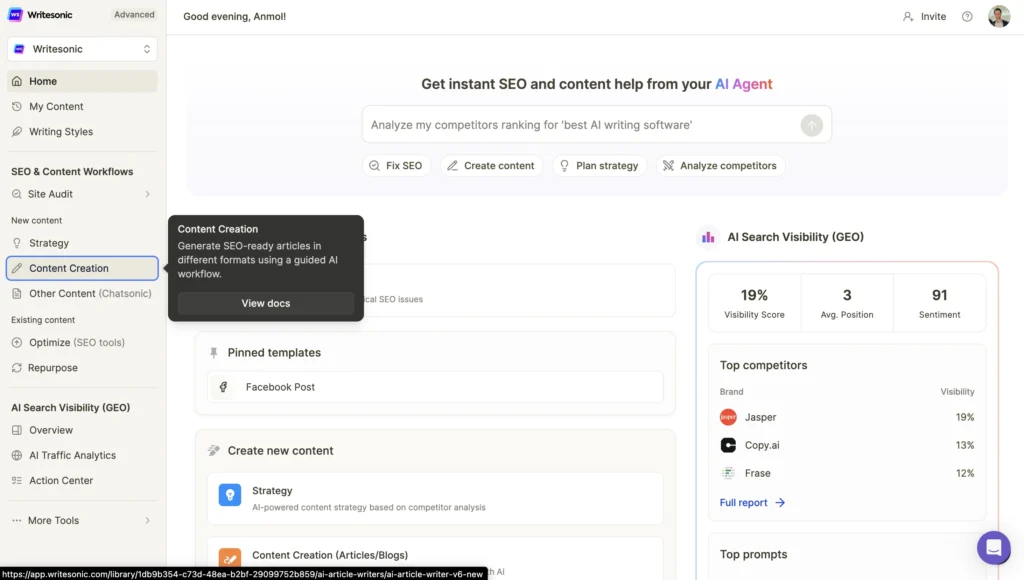
Instead of simply optimizing your content for Google’s traditional blue links, Writesonic now tracks how often – and how well – your brand is mentioned when people ask AI chatbots questions. Here’s an example. Someone asks ChatGPT “what’s the best project management app,” and your brand never appears, that’s traffic you’re missing that a regular SEO audit would never pick up on, because it’s not even happening on a search results page.
Writesonic’s GEO toolkit covers a few specific things I tested:
Prompt tracking: You generate prompts relevant to your brand or niche and Writesonic tracks the responses of AI platforms to them over time, letting you know if you are being mentioned, ignored or falling behind a competitor.
Multi-platform coverage : Depending on your plan , you can track not only ChatGPT but also Google AI Overviews and Gemini . Why does that matter ? Different AI engines draw from different sources .
Action Center: This is essentially a prioritized to-do list based on your GEO and SEO data things like “add a comparison table here” or “your competitor is cited on this page and you’re not.” This seemed more actionable than a list of scores.
Sentiment tracking: On the pricier plans, it can tell you not just if you’re mentioned but whether the mention is positive, neutral or unflattering.
This GEO layer is truly forward thinking if you are already investing in traditional SEO content because AI-driven search traffic is not a future trend – it is already redirecting real clicks away from classic search results.
Writesonic AI Article Writer Test
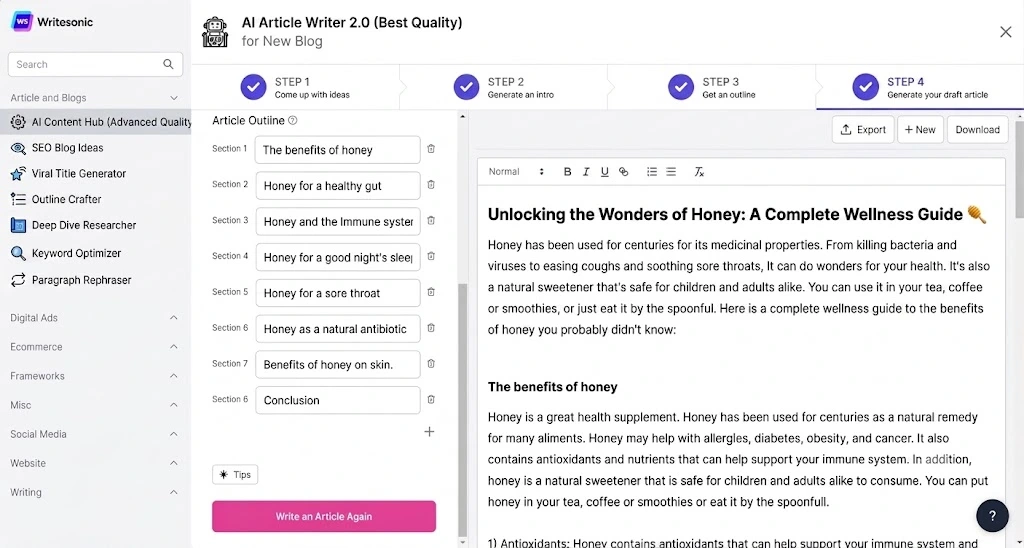
I didn’t want to just talk about the article writer theoretically, so I ran a real test: I gave it a medium-difficulty blog brief on a topic I already know well, so I could judge accuracy without having to fact-check every line from scratch.
In under two minutes, the first draft had a clean outline – intro, five H2 sections and a conclusion. The good news is that the outline logic was smart and it picked subtopics that I would have included myself. The rough part: a couple of sentences came across as generic, the sort of filler phrasing you can instantly identify if you’ve read a lot of AI output, and one of the statistics it generated required checking because it wasn’t sourced.
My general impression from the Writesonic AI article writer test: It’s a decent first-draft generator, not a “publish and forget” tool. Budget for time spent editing especially for anything that cites numbers, dates or specific claims.
If you’re wondering how this compares to a general purpose model on the same brief, I broke that down separately in my full ChatGPT vs. AI writing tools comparison on this site – worth a read if you’re deciding between the two.
Is Writesonic Good for SEO Content?
Short answer: yes, with a caveat.
The SEO Checker does a really good job of comparing your draft to what is ranking right now and the site audit tool catches technical issues that would otherwise sit unnoticed on your blog for months. If your biggest SEO problem is “I don’t know what my competitors are covering that I’m not,” Writesonic fills that gap fast.
The problem is it lacks depth. It’s good at getting you to page-one competitive baseline, but for truly tough, high-competition keywords you’ll still want a human strategist making the final calls on internal linking, search intent nuance and editorial judgment. I would call it a strong assistant for SEO content, not a substitute for an SEO-literate editor.
Source: Writesonic AI Article Writer
Writesonic Pricing (2026)
Writesonic has noticeably changed its pricing this year as the platform added GEO tracking to its core plans, instead of selling it separately. In terms of the current published pricing, here’s a rough idea of what you’re looking at:
Free Plan : No credit card needed. Enough to test the interface and basic templates. But the useful features – the full article writer and GEO tracking – are locked or heavily capped.
Starter: About $79/month if paid annually (around $99/month if paid monthly). This includes 1 user, 1 project, roughly 15 AI articles per month, some site audits and GEO tracking limited to ChatGPT only.
Basic: $199/month billed annually. GEO tracking is also added across more AI platforms including Google AI Overviews and Gemini. It increases your article cap and expands site audit limits.
Growth: Around $399/mo (billed yearly). It is the most popular self-serve tier and is aimed at small content teams who need more volume, more seats and more depth of GEO tracking capacity.
In most cases, you won’t be able to carry over unused credits or article caps from one month to the next. Extra seats or article packs will cost you more on top of your base plan. If price is your biggest concern, check out Writesonic’s current pricing page before you commit since AI tool pricing structures change often.
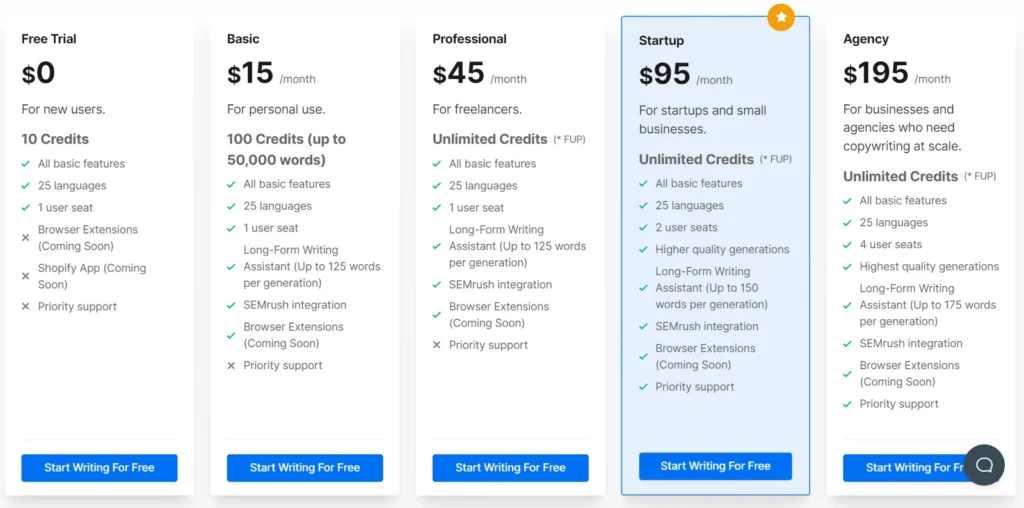
Writesonic’s official pricing page is the best way to get the exact live numbers before you buy, as plans and caps change more frequently than most SaaS tools.
Writesonic vs ChatGPT for Blogging
This is the comparison I get asked about the most, so let me break it down for you.
One such conversational model is ChatGPT. It can write nearly anything given the right prompts, is inexpensive (or even free), and is very versatile. However, it does not include an SEO audit feature, does not automatically structure blog posts for search engines, and does not automatically track your brand’s visibility across AI search platforms.
Writesonic is especially built for blogging and content marketing. It creates structured drafts with SEO scoring built in, automatically benchmarks your work against competitors, and has that GEO tracking capability ChatGPT doesn’t have.
If you’re an occasional blogger and comfortable carefully prompting and doing your own SEO research, you can absolutely get the job done with just ChatGPT, and it’s a lot cheaper. But if you’re publishing consistently and want SEO scoring, site audits and AI-visibility tracking without stitching together three separate tools, Writesonic is worth its subscription price. I actually use both in my own workflow – Chatsonic (Writesonic’s chat tool) for quick real-time research questions, and the Article Writer for the structural first draft, then I still open up to using ChatGPT occasionally for brainstorming angles.
Is Writesonic Legit?
I want to answer this question straight up because I know it’s the question that got a lot of people to click on this post in the first place. Yes, Writesonic is a legitimate and actively maintained company. No, this isn’t a scam or some fly-by-night SaaS wrapper.
Here are some reasons I can comfortably say that:
It has a long history. Well before the current AI hype cycle, Writesonic has been around since 2020 with millions of users on its platform.
Volume supports it. It boasts thousands of verified reviews on G2, Capterra and Trustpilot, with the vast majority of reviews being positive.
Billing is simple, if sometimes maddening. The one common complaint I saw in user reviews was not about being scammed, but about credit limits, word caps, and having to upgrade sooner than expected. That’s an annoyance with usage limits, not a sign of illegitimacy.
It has actual infrastructure. Multi-model integration, live customer support channels and a real product roadmap point to an established company not a one-man operation running ads.
My personal read after using it: Writesonic is legit but go in with realistic expectations about credit limits so you’re not caught off guard mid-month.
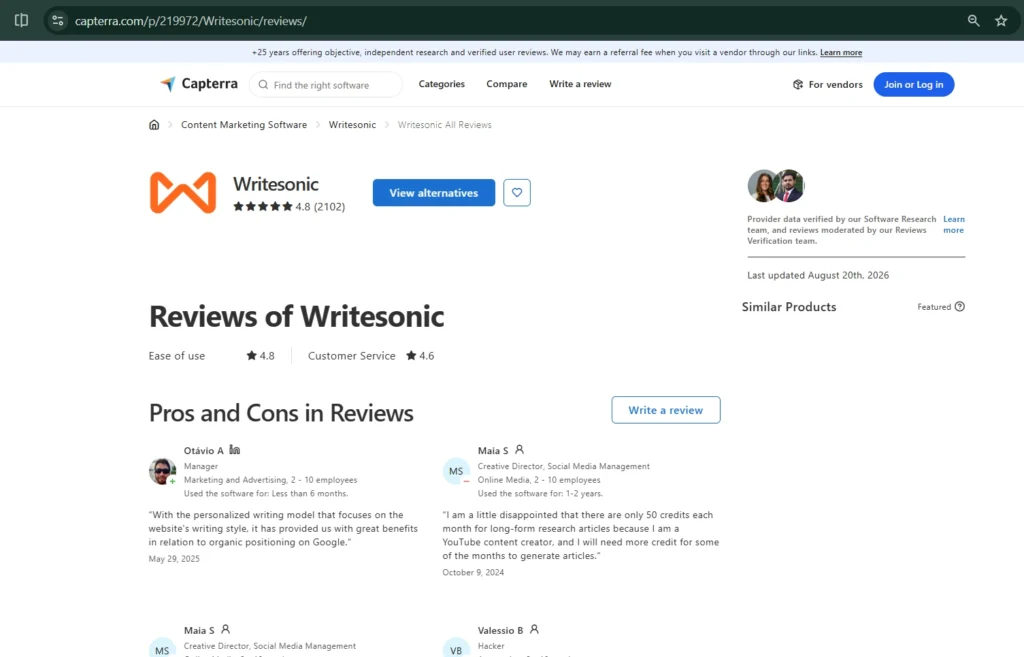
You can see the raw user feedback for yourself on Writesonic’s Capterra review page, where I took most of the sentiment patterns above from.
Writesonic Alternatives
You might find a better fit with one of these alternatives than with Writesonic, depending on your needs and budget.
Jasper: Great for bigger marketing teams needing better brand-voice consistency, but more expensive per seat and lacks a dedicated GEO tracking layer.
Copy.ai: Now more of a go-to-market platform than a pure writing tool, with pricing that jumps sharply at higher tiers.
Rytr: Most bang for your buck. Cheap, simple, no GEO or advanced team features, good for solo creators that just want quick drafts.
Surfer SEO: Not a writer per se, but a content optimization tool that many people run alongside ChatGPT instead of using an all-in-one platform like Writesonic.
Frase: A lighter-weight competitor focused on research and outlining that some smaller teams prefer to Writesonic’s broader feature set.
If you only need to track GEO and AI visibility and don’t need the writing tools, consider dedicated visibility platforms rather than an all-in-one suite. But if you want writing, SEO auditing and AI visibility tracking all in one login, the list of true Writesonic alternatives gets thin fast – that exact combo is still pretty rare.
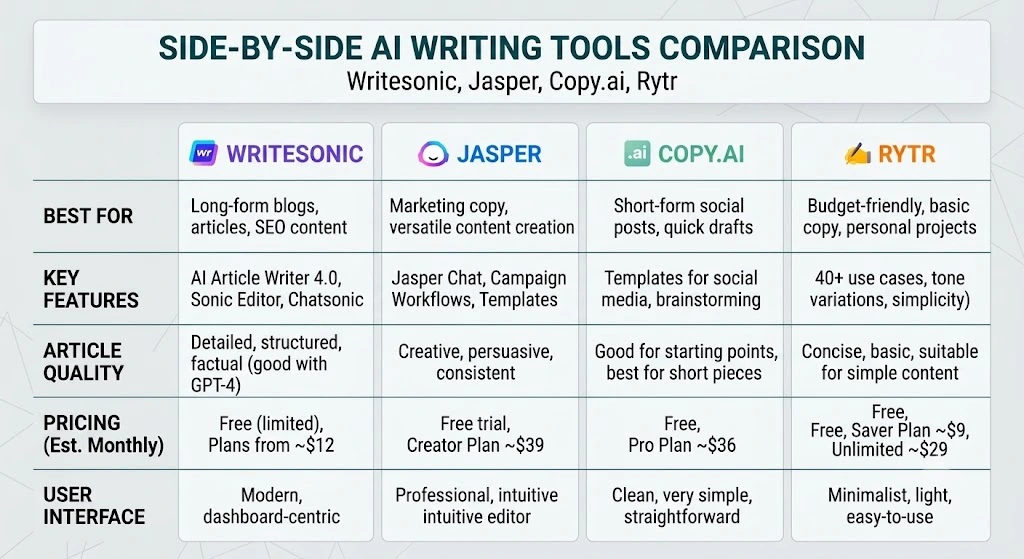
I also wrote a deeper breakdown of my favorite AI writing tools if you want a wider list than just these five.
Pros and Cons — My Honest Summary
Pros:
Truly useful first-draft generator that saves actual time on structure and research
SEO Checker helps you quantify how to bridge competitive content gaps
GEO tracking is ahead of most competitors and addresses a real, growing blind spot
Multi-model access ( GPT-4, Claude, Gemini) rather than being locked in to one AI engine
WordPress and Zapier integrations mean less manual publishing
Cons:
Credit and article caps can be limiting when you are publishing consistently.
Long form drafts still need real human editing before they are ready for publication
Pricing has become less transparent with the bundling of GEO features into tiers
Customer support response times were inconsistent during my testing
Final Verdict: Should You Use Writesonic in 2026?
My impression after using Writesonic for a month is that it justifiably ranks among the best all-in-one AI content platforms available today. Not only does it write, but it also tells you how well your content is performing on Google and in AI chat responses. That is an extremely unusual combination.
I wouldn’t recommend it if you’re only ever going to write a handful of posts a year, a free ChatGPT account will cover that just fine. But if you’re publishing regularly, and want the SEO scoring, technical audits and AI-search visibility tracking, without juggling three separate subscriptions, it’s worth the money — as long as you go in understanding the article caps, and budget real editing time for every draft it hands you.
This platform has shifted gears rapidly in the past year alone, so I’ll keep updating this Writesonic review as pricing and features shuffle around throughout the rest of 2026.
FAQs
Is Writesonic AI free to use? There is a free plan, but it is limited to basic templates and a small word allowance. Paid plan includes full article writer and GEO tracking tools.
What is Writesonic Pricing in 2026 ? What is Writesonic Pricing 2026? Pricing currently ranges from a free tier to around $79 to $399 a month depending on the plan (billed annually) with custom Enterprise pricing above that.
Is Writesonic legit or a scam? It’s a legit company, been around since 2020 and has thousands of verified user reviews on all the major review platforms. Most complaints are about limits of use, not the legitimacy of the use.
Writesonic vs ChatGPT for blogging: – which one should I choose? ChatGPT is cheaper, more flexible for general writing. If you want SEO scoring, site audits and AI search visibility tracking all bundled with your writing tool, Writesonic is better.
Is Writ esonic good for SEO content? Yes, for closing competitive content gaps and catching technical SEO issues. For super competitive keywords you’ll still want human editorial judgment on top of that.
What is an alternative to Writesonic? It’s a question of your priority. Jasper is for brand-heavy teams, Rytr is for tight budgets and Surfer SEO is for those who want optimization without a writer included.
Discussion (0)
No comments yet. Start the discussion below!
Leave a Comment